
Following on my from previous article on AI Search Visibility, I’m happy to share another with more detail as Google did us all a solid and gave clearer (we use the term lightly these days) guidance on how to optimise websites for generative AI Search.
By David Douglas, Founder, Ebow Digital
The good news? You probably don’t need to reinvent your entire SEO strategy. The less good news? Being average is becoming increasingly difficult to hide. You MUST stand out and you MUST have definitive tone of voice and stand for something.
In May 2026, Google published new guidance addressing how websites can improve their visibility within generative AI features such as AI Overviews and AI Mode.
And there is one super important message running through (almost) all of it:
Good SEO is still good SEO. But good content needs to get considerably better.
Google says its AI search experiences remain rooted in its core search ranking and quality systems. So the fundamentals that have always mattered, technical SEO, crawlability, useful content, authority and a good user experience, still matter. Maybe even more.
A major change is ‘how’ people search, how Google assembles answers and how brands earn visibility within those answers.
SEO isn’t dead. It’s evolving…fast and in quite a confusing, and very disruptive, way.
There has been no shortage of new terminology surrounding AI search.
AEO. GEO. AI SEO. LLM optimisation. Blah blah blah…but not…

Google’s position is pretty straightforward: from its perspective, optimising for generative AI search is still fundamentally SEO. There are no special technical requirements that magically make your new web design or older website appear within AI Overviews or AI Mode.
That doesn’t mean nothing has changed though.
Google’s generative search systems can use techniques including retrieval-augmented generation (RAG – I’ve hounded our CTO about this!) to retrieve relevant and current pages from its search index and use them to help construct answers.
They can also use what Google calls query fan-out. This is a big feature and component.
Behold Chaka Fan:

Instead of treating a search as one isolated query, Google’s AI can generate multiple related searches to investigate different aspects of the original question before constructing its response.
In simple terms, Google is getting better at understanding the whole question rather than simply matching the words somebody typed. (We’ve spent 20 years being told it understands everything…)
That’s significant for brands like yours and ours.
Stop creating boring / commodity content.
Perhaps the most important phrase in Google’s new guidance is “non-commodity content.”
For years, search results have been filled with articles saying essentially the same ol’shlock.
Search a question and you’ll often find ten websites providing slightly rearranged versions of the same answer. Top 10 answers to 1 non-answer!
Generative AI makes that strategy considerably less valuable.
If an AI system can ‘synthesise’ the basic answer from hundreds of sources, there is little reason for it, or whoever is searching, to value yet another generic 1,500-word article covering exactly the same ground.
Google is explicitly encouraging websites to create unique, valuable, expert-led content that provides something beyond commonly available information.
That could mean:
- First-hand experience.
- Original research.
- Expert opinion. (Tick LOL)
- Proprietary data.
- Case studies.
- Real-life examples.
- Original photography and video.
A genuinely useful perspective.
In other words, create something worth talking about or sharing.
Your brand, and its tone of voice and its essence, matters even more now, not less.
This is where AI search becomes particularly interesting. When everybody can produce content, simply producing content is no longer much of a competitive advantage.
Credibility is. Relevance is.
That makes your expertise, reputation, experience and distinctive point of view increasingly important. You’ve got to stand for something…more.
Google reinforced this direction again last May when it expanded features designed to surface original content and trusted sources within AI Search, including bringing Preferred Sources into AI Overviews and AI Mode.
For brands, the objective is now more than just ranking for keywords. It is to become a recognisable and authoritative source within your category.
That’s a much bigger challenge than adding another keyword to an H1.
And potentially a much bigger opportunity.
Don’t create hundreds of pages for AI though. One temptation with generative AI is to create pages answering every conceivable variation of a question but Google specifically warns against this.
Its systems can understand the relationship between a page and a search without requiring an exact keyword match. Producing large quantities of pages primarily to manipulate rankings or generative AI responses can also fall foul of Google’s policies on scaled content abuse.
So rather than creating:
50 thin pages answering 50 slightly different questions
Google favours:
one genuinely authoritative resource that answers the subject brilliantly.
Think depth, usefulness and expertise rather than sheer volume. This is a good thing, the web needs it otherwise we’ll become inundated with even more terrible content.
It is still essential to get the basics right:
- Clear site architecture
- Design systems
- Crawlable content
- Strong internal linking
- Descriptive page titles and headings
- Useful images and video
- Fast, accessible pages
- Sensible use of structured data where appropriate
- Minimal duplication
- Proper JavaScript implementation
- A good experience across mobile and desktop
Google also recommends using semantic HTML where practical, although it explicitly says websites do not require perfectly valid semantic HTML to appear in generative search.
The principle is simple:
Don’t make Google, or your beloved customers, work unnecessarily hard to understand your website.
Think beyond text. Google’s guidance specifically calls attention to images, video, shopping information and local content.
That means brands should stop thinking about optimisation as something performed exclusively on written copy.
- A useful product demonstration.
- An original diagram.
- A well-produced explainer video or showreel. (Not some AI slop)
- Strong product photography.
- Detailed case studies.
- Good social media content.
- Accurate local business information.
These are all parts of the information ecosystem surrounding your brand and its digital marketing strategy.
And as AI search becomes better at understanding different forms of media, they become increasingly valuable assets for discovery.
Perhaps one of the most useful parts of Google’s announcement is what it tells businesses not to obsess about. Google explicitly cautions against supposed AI optimisation tricks such as artificially “chunking” content, creating unnecessary AI-specific text files such as llms.txt, or chasing low-grade mentions simply to influence Google.

There isn’t a secret switch marked Rank Me in AI. We wish there was!
The fundamentals remain pretty simple, yet considerably more important.
- Build a technically excellent website.
- Publish useful things.
- Demonstrate genuine expertise.
- Build authority around your brand.
- Make your information easy to find and understand.
View the full TRB Chemedica Case Study.
Search is becoming a conversation
The bigger change isn’t really SEO. It’s how us lot (humans) behave. And we’re all bonkers.
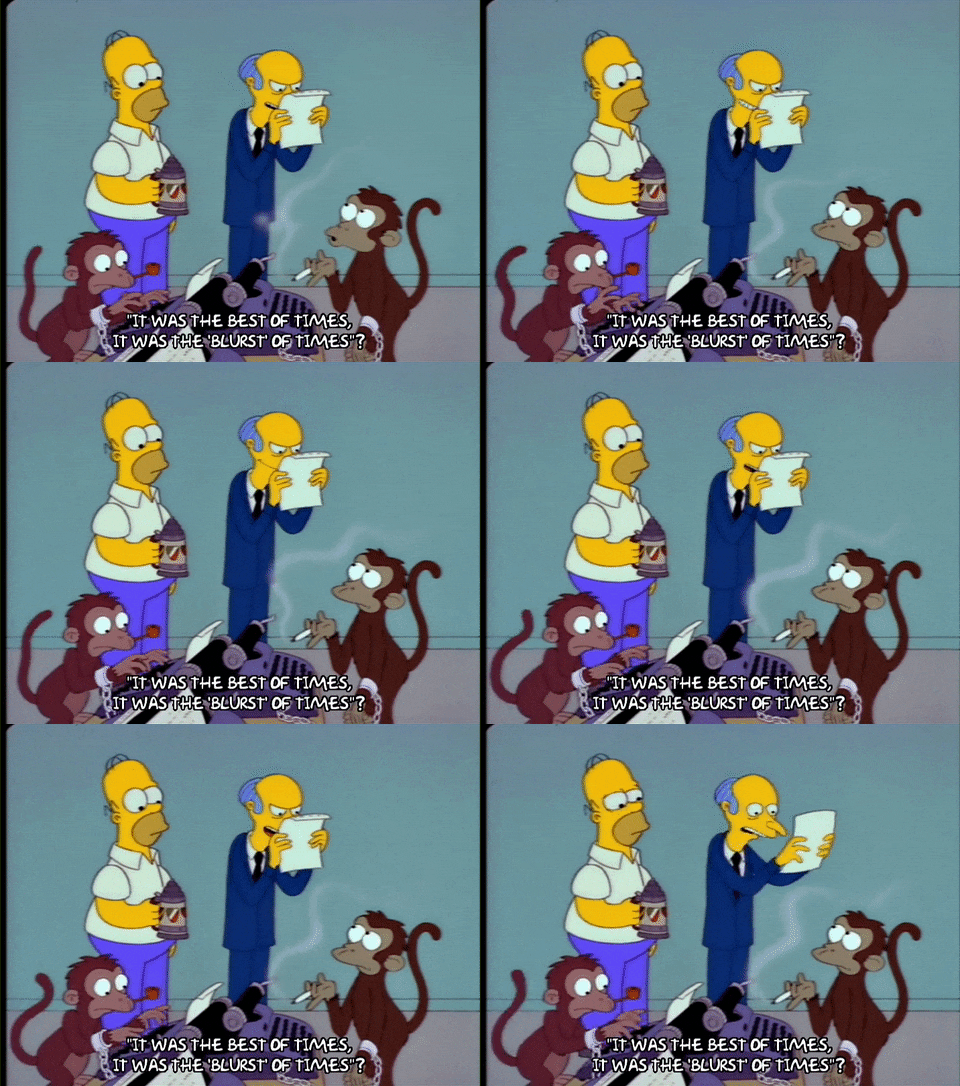
Traditional search encouraged short queries:
“best digital agency Dublin”
Generative search allows somebody to ask something much closer to the question actually in their head:
“We’re an Irish financial services company planning a website redesign to aid international expansion. What should we look for when choosing a digital agency with experience in branding, technology, SEO and regulated industries?”
That’s an entirely different search experience.
Google says AI Mode users are asking longer, more complex questions and using Search conversationally to explore subjects rather than simply submitting isolated queries.
For brands, this means understanding the questions surrounding the buying decision, not merely the keywords associated with the product. It means nuanced answers and content around what it is you’re selling.
Your website needs to demonstrate that you understand the subject, the problem and the customer.
What should brands do now?
We wouldn’t recommend throwing away your SEO strategy and starting again. We would recommend widening it. Continue investing in technical SEO and the search fundamentals that make your website discoverable. But combine it all with a stronger focus on authority, expertise and original, cool content.
Stand in front of the proverbial mirror and ask yourself:
- What do we know that everybody else doesn’t?
- What experience can we demonstrate?
- What questions do people repeatedly ask us?
- What original research or data could we publish? (Always a tricky but very, very powerful one)
- What case studies prove what we claim?
- Where can our people demonstrate genuine expertise?
- What would make somebody trust our answer over the hundreds of alternatives available online?
And perhaps most importantly:
If AI had to recommend sources for our area of expertise, have we given it a reason to include us? (As mentioned in other articles, a Reason to Believe is super important, just ask Rod!)
SEO, AEO and GEO are becoming part of the same battle and Google’s guidance confirms something we’ve believed for some time.
SEO isn’t disappearing. It’s expannnnnndinnnnnnnggggg.
More conversational, more contextual and more capable of understanding the relationship between questions, content, entities and brands.
You can see 2 Ebow Digital clients below in the answers:
You must ensure that your brand is discoverable, understandable, credible and worth referencing wherever people or machines go looking for answers.
At Ebow Digital, we see SEO, AEO and GEO as connected parts of the same challenge: making sure your brand is visible when people are making decisions. Branding is so important!
Because whether the answer comes from ten blue links, an AI Overview or a conversation with an AI assistant, the objective hasn’t really changed.
Just like in life! You need to be found. You need to be trusted. And you need to give people a reason to choose you.
So…welcome to the zero-click world
And that’s my segue into another big change happening alongside all of this: zero-click marketing.
What is zero-click marketing?
“Zero-click marketing is the practice of building brand visibility, trust and influence in places where people can get the information they need without ever clicking through to your website.”
Think Google AI Overviews, ChatGPT, Gemini, social feeds, featured snippets and other platforms that increasingly answer the question right there and then.
Traditionally, the game was fairly straightforward: Search 2 click 2 website 2 hopefully do something.
Now it can increasingly look like:
Ask 2 answer 2 brand discovered 2 no click.
That might initially sound terrifying to anyone who has spent years staring lovingly at Google Analytics, but zero clicks doesn’t necessarily mean zero value. It does mean that attribution is about to get even trickier though.
If your brand is being referenced, recommended, quoted or simply becoming familiar to someone while they’re researching a subject, you’re still influencing the decision. The click might come later. Or they might search specifically for your brand. Or they may never visit your website at all before deciding you’re one of the businesses they want to speak to.
That means we need to start thinking beyond “How do we get the click?” and ask a bigger question:
“How do we make sure our brand is part of the answer?”
And that brings us straight back to AI search optimisation. Your content needs to be useful enough to surface, distinctive enough to be remembered and authoritative enough to be trusted.
In the zero-click world, visibility itself has value.
It’s just another front in The Battle for Hearts and Minds.
And we know how to help you win it!
(find our more about our AI Search Agency services here if you’re interested or contact us now)
❤️ 🧠
Dave.
A little about me:
I founded Ebow in 1999. Since then, technology has changed beyond belief. But people haven’t changed nearly as much. That’s ultimately where our Battle for Hearts and Minds comes from: understand people first, then use strategy, design, technology and marketing to give them something worth thinking and feeling.
Read more about our history in The Story of Ebow.
Go ahead and connect with me on LinkedIn.
Or just check out our showreel: